Home » Jazz Articles » Interview » Dan McCarthy: A Place Where We Once Lived
Dan McCarthy: A Place Where We Once Lived
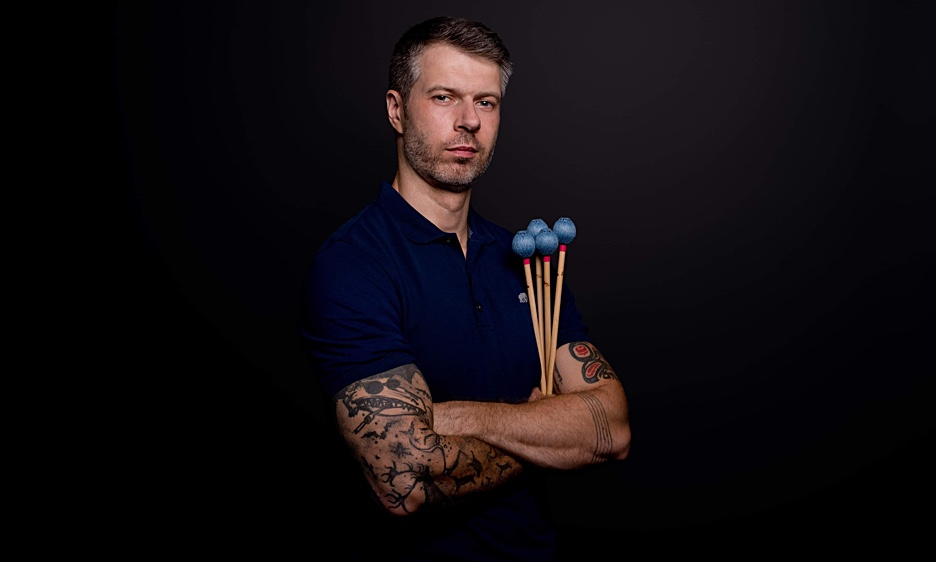
Courtesy John Rogers


Dan McCarthy
vibraphoneb.1980
A Place Where We Once Lived (Self-Produced, 2021), the gorgeously reflective outcome of that trio session with bassist

Thomas Morgan
bass, acoustic
Rudy Royston
drumsThe music—all original(s), save for

Steve Swallow
bassb.1940
Every aspect of A Place Where We Once Lived, from the album's title to the cover photo taken in front of McCarthy's apartment on Pacific Street in Crown Heights, speaks to New York life. And that includes the inspiration for connecting with this rhythm team, the creative process itself and a general desire to live in the moment: "This trio record was really inspired by a night at the Village Vanguard when I heard

Bill Frisell
guitar, electricb.1951
The trio only recorded one or two takes of each piece during that session, and virtually everything that ended up on the album is a first take. While speaking to a high level of concentration and musicianship, that fact also nods to immediacy in the air. "If you record multiple takes they'll always be different, but the second and the third will never really be better than the first," McCarthy notes while personalizing a widely-held principle. "That's because that first take is the first time experiencing something. You're telling a new story versus trying to tell the same story a different way. Those first takes are so powerful because you're really, actually, speaking for the first time instead of trying to repeat something you've heard or said before." That near-tangible power in the music addresses the spontaneity in first flights, but it also connects to a sense of purpose straddling different points in this artist's life. Marking the end of an era for McCarthy, the creation of A Place Where We Once Lived served as a segue into a new phase (more on that later) and a return to the place where he grew up and initially found his way.
Born and raised in Toronto, Dan McCarthy came to music early on. "I started when I was three," he shares. "My parents put me in a community music school. They really put me in everything— hockey, swimming, French—and music was just one of those things." Picking up the basics in his preschool years, and taking piano lessons from middle childhood on into his early teens, McCarthy received a solid foundation. Then, when it was time to choose an instrument, he was drawn to the drums. "I'm not sure why I chose the drums, to be honest. They just looked like fun," he confesses. "So I played drums for quite a while. I went to an arts high school, and that's what I studied there." Were it not for bad timing (no pun intended), drums may have remained front and center for McCarthy. But fate, of course, stepped in. "One of the requirements for all percussion majors at the high school was to be part of the percussion ensemble," he explains. "We had lunchtime rehearsals. And one day, at the beginning of my senior year, I was late. I took too long eating before I went there and by the time I made it to rehearsal, the only instrument left, because nobody wanted it, was the vibes [laughs]. I sort of hated it for the first few months I played, but then I came around. I started to enjoy it. I realized how unique it was, that no one was doing it and that I was actually getting some attention for it."
With only a year of vibraphone work behind him, and absolutely no doubt about a desire to pursue music, McCarthy's audition for Humber College focused primarily on drum set. By his sophomore year, however, it was all vibes all the time. McCarthy managed to take off on the instrument, with some help from mentor

Don Thompson
bassb.1940
At that point in time, McCarthy's main aim was to play as much as possible. He spent three years doing just that, honing his skills and working close to home, before serendipity sought him out and swept him away to New York. "It all came through Gordon Webster, a good friend who's probably still, to this day, one of the best piano players I've ever met. We had gigged together for a few years in Toronto, and then Gordon decided he wanted to go and get his master's degree at the Manhattan School of Music. He got an apartment in Washington Heights and was set with a roommate who was also supposed to be going to school there. But in July, after Gordon had already signed the lease, his roommate bailed." As Webster explained the situation to McCarthy at that moment, he asked his friend to keep an ear open for anybody who might be interested in joining him. And when McCarthy told the story to his girlfriend, she reminded him of his own deep desire to make that jump.
With no visa, very little money, no job and no connections, moving to New York was far from a safe move for McCarthy at that particular juncture. But the more he thought about it, the more he realized that the moment felt right. "I couldn't stop thinking about it for a week after I had that conversation. So I just decided I was going to go for it...and less than a month after Gordon had introduced this idea to me, I was in New York." Arriving on August 15, 2004, McCarthy had no clear direction. But within a few months he was finding his way. Through Webster and another Torontonian-turned-New Yorker—trumpeter

Suresh Singaratnam
trumpet
George Garzone
saxophone, tenorb.1950

Chris Lightcap
bassb.1971

Gary Versace
piano
Rez Abbasi
guitar, acousticb.1965
McCarthy's work at Cornelia Street Café, which lasted five years, created additional opportunities. When the club's owner, Robin Hirsch, opened another establishment—Night and Day, in Brooklyn—he asked McCarthy to run the music booking for its back room. "I did that for about a year," he recalls. "And that included booking a weekly jam session. So between all of that, and people dropping off demos, I made a lot of connections there too." Concurrently, McCarthy was gigging and developing his own voice as a composer, which led to the recording and release of his debut album— Interwords (Self-Produced, 2006). "I'd been playing a lot with [bassist]

Matt Wigton
bassb.1980
Greg Ritchie
drums
Myron Walden
saxophone, altob.1972

Brian Blade
drumsb.1970
Certain aspects of that maiden voyage were in the modern tradition, but McCarthy's sophomore release—in co-led ensemble Tucksy, with some jazz-pop proclivities and a vibraphone-and-banjo frontline—was definitely a departure from the norm. "That band came about because of that booking work at Night and Day," McCarthy details. "During one of the sessions there, this guy named " data-original-title="" title="">Tuey Connell came in and we had this great conversation for about two or three hours. It turned out he was a banjo player. We became friends and we started to get together to play a little bit. We started to gather some other people to join us, so I tapped [bassist]

Dan Loomis
bassb.1980

Ernesto Cervini
drumsb.1982
That inceptive period in New York, centered in many ways on Cornelia Street Café, enriched McCarthy's music and life. But making a living in Gotham wasn't easy. When asked about when he finally found his footing and felt comfortable, the vibraphonist was completely frank: "I found it to be a struggle for all 15 years [chuckles]." Filled with ups and downs, both in and out of music, McCarthy worked hard to carve out his own place. And in the process of dealing with that stress and rekindling a love for fitness formed in his youth, he began to move away from performing. "After I was in New York for a few years I kind of felt really out of shape, so I started running and exercising. Then I really started to get into fitness," he explains. "And a little later, with me wanting to take a step back from music and follow a different career path, things just lined up really well. Through some fortunate connections I made, I met people who helped facilitate things so I was able to open a gym [in late 2012]." Focusing almost exclusively on owning and operating that enterprise, music was pushed to the periphery. But its absence made the heart grow fonder, as McCarthy shares: "After a few years I just really missed it. So I started practicing all the time and decided I wanted to get together with some people and make music again."
Renewing his relationship with the vibraphone, McCarthy eventually returned seriously to music while still running the gym. And when he and his family made the choice to sell that business and move back to Toronto, he sought to make some jazz dreams come true before departing. "When I decided to leave New York and move back to Canada, I had about a year-and-a-half of lead time. So I sort of [realized] I needed to make the most of it," McCarthy explains. "I started reaching out to people that I always wanted to play with to see if they'd be willing to make a record with me." The first fruit of that decision was Epoch (Origin, 2019), with violinist

Mark Feldman
violin
Ben Monder
guitarb.1962
Steve Swallow
bassb.1940
Since returning to Toronto in February of 2019, in a move prompted by the promise of a more settled family atmosphere and a fellowship lined up for graduate work in composition at York University, McCarthy has remained musically active while reconnecting with mentors and friends. Celebrating the homecoming three months in, he recorded City Abstract (Origin, 2019) with guitarist

Ted Quinlan
guitar
Pat Collins
bass, acoustic
Ted Warren
drumsb.1965

Carla Bley
piano1938 - 2023

Pat Metheny
guitarb.1954
Burton's influence, which obviously looms large, also extends to McCarthy's Hunter S. Thompson project, which was the topic of his master's thesis and will likely be the focus of his next jazz record. "It's kind of unique. I originally wanted to put together a quintet that mirrored Gary's band from the '70s—with two guitarists, like when
Pat Metheny
guitarb.1954

Mick Goodrick
guitar1945 - 2022
Steve Swallow
bassb.1940

Bob Moses
drumsb.1948
While the long road from the rise of COVID-19 to the spring of 2021 has come with many challenges, both obvious and not, nothing has been insurmountable for McCarthy. This artist has learned to overcome and, in many ways, the pandemic has made him more active than ever. Sharpening his skills as a solo vibraphonist, McCarthy posted a series of impressive videos on social media. Through forced downtime he found the opportunity to dig into the archives and release some sessions like The Toronto Quartet EP (Self-Produced 2020), which takes things back to 2001 and provides a glimpse of the young Dan McCarthy in almost the exact same company as on City Abstract, and Méjis (Self-Produced, 2020), which was recorded in New York in 2018 and features pianist

Randy Ingram
pianob.1978

Michael Bates
bass
Jeff Davis
drumsb.1952
Tags
Interview
Dan McCarthy
Dan Bilawsky
Thomas Morgan
Rudy Royston
Steve Swallow
Bill Frisell
Don Thompson
Suresh Singaratnam
George Garzone
Chris Lightcap
Gary Versace
Rez Abbasi
Myron Walden
Brian Blade
Tuey Connell
Dan Loomis
Ernesto Cervini
Freed Kennedy
Mark Feldman
Ben Monder
TED QUINLAN
Pat Collins
Ted Warren
carla bley
pat metheny
Mick Goodrick
Bob Moses
Randy Ingram
Michael Bates
Jeff Davis
Comments
PREVIOUS / NEXT


Support All About Jazz
 All About Jazz has been a pillar of jazz since 1995, championing it as an art form and, more importantly, supporting the musicians who make it. Our enduring commitment has made "AAJ" one of the most culturally important websites of its kind, read by hundreds of thousands of fans, musicians and industry figures every month.
Go Ad Free!
To maintain our platform while developing new means to foster jazz discovery and connectivity, we need your help. You can become a sustaining member for as little as $20 and in return, we'll immediately hide those pesky ads plus provide access to future articles for a full year. This winning combination vastly improves your AAJ experience and allow us to vigorously build on the pioneering work we first started in 1995. So enjoy an ad-free AAJ experience and help us remain a positive beacon for jazz by making a donation today.Showcase
 Buy Now
Featured
Darwin AI: Surivior Choice
By Alex Otey buy